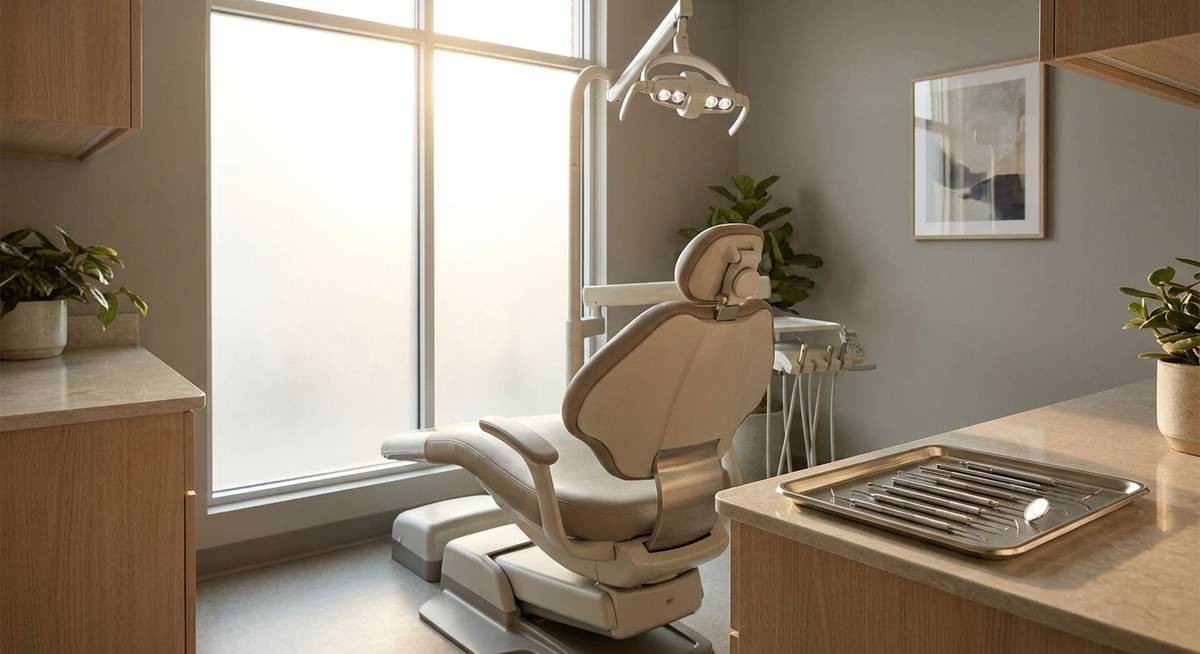
You wake up with a sore jaw. Your partner says you were grinding all night. Your last dentist handed you a night guard and called it a day. But the grinding came back — because a night guard treats the symptom, not the cause. At Dr. Jared Dental Studio in Miami Shores, we take a different approach: if you’re grinding your teeth, we want to know why your airway is keeping your body up at night in the first place.
The Real Reason You Might Be Grinding Your Teeth
Teeth grinding — known clinically as bruxism — is one of the most misunderstood conditions in dentistry. The reflex explanation is stress: you’re tense, you grind, you wear down your enamel. Stress can absolutely be a factor. But research is increasingly pointing to something that happens while you’re asleep and mostly unconscious: your airway narrowing.
When your throat partially closes during sleep, your brain doesn’t stay passive. It fires off a signal to the muscles of your jaw and tongue — move the jaw forward, reopen the airway, keep breathing. Your body is trying to protect itself. The grinding and clenching are a side effect of that protective reflex. A 2026 analysis published in the Journal of Clinical Sleep Medicine found that 73.5% of sleep bruxism cases are associated with obstructive sleep apnea or airway-related breathing disruption. That’s not a fringe finding — that’s the majority of nighttime grinders.
Here’s the problem with handing you a night guard and sending you home: it protects the enamel, but it does nothing about the airway. Your body will keep triggering the jaw reflex every time your breathing falters. You’ll crack through guards. Your jaw will keep hurting. Your sleep will keep being fragmented — even if you don’t fully wake up.
What Airway Dentistry Actually Does
Airway dentistry is a functional approach that treats the structural causes of sleep-disordered breathing from the dental side. The jaw, the tongue, the soft palate, the width of the dental arch — all of these influence how open your airway is when you lie down. A dentist trained in airway assessment can evaluate those structures in a way a sleep physician or an ENT typically won’t.
At Dr. Jared Dental Studio, the airway dentistry for adults evaluation looks at:
- Jaw position and bite — is your lower jaw sitting too far back, crowding the airway?
- Tongue posture — low tongue posture contributes to airway collapse at night
- Dental arch width — a narrow arch leaves the tongue with nowhere to rest except the floor of the mouth, directly impacting breathing
- Signs of grinding and clenching — flattened teeth, cracked enamel, jaw muscle hypertrophy (enlarged jaw muscles from overuse), and worn-down cusps
- Sleep quality symptoms — waking unrefreshed, morning headaches, fatigue through the day, difficulty focusing
If those signs point toward an airway contribution, treatment options go well beyond a passive night guard. Custom oral appliances that gently reposition the lower jaw forward can keep the airway open during sleep — addressing both the breathing disruption and, in many cases, the grinding reflex that follows it. For patients with more complex airway or structural issues, we coordinate care with sleep physicians and airway-trained specialists to get to the right diagnosis.
Why Headaches and Jaw Pain Keep Coming Back
One of the most consistent complaints from patients who come to us with bruxism is chronic morning headaches. The jaw muscles — the masseter and temporalis — are extraordinarily strong. When they fire repeatedly through the night, the resulting muscle tension radiates into the temples, behind the eyes, and down the neck. Many patients have spent years being treated for “tension headaches” with no resolution, because nobody addressed the 6–8 hours of nightly jaw clenching behind the headaches.
Jaw pain itself can progress into more significant joint issues over time. The temporomandibular joint (TMJ) absorbs the mechanical load of grinding. Chronic overloading leads to disc displacement, clicking and popping, and in more advanced cases, structural changes to the joint itself that become much harder to treat. Catching the pattern early — before the joint is damaged — makes the intervention far simpler and more effective.
The American Academy of Sleep Medicine has flagged the connection between sleep-disordered breathing and bruxism as a priority research area, and the National Institutes of Health recognizes bruxism management as a condition requiring interdisciplinary coordination — not just a single-discipline quick fix.
Signs You Should Get Your Airway Assessed — Not Just a Night Guard
If any of these sound familiar, a standard bite guard may not be your answer:
- You wake up with jaw soreness, headaches, or neck tension most mornings
- You’ve gone through multiple night guards, or cracked one
- Your partner reports snoring, restless sleep, or pauses in breathing
- You feel like you slept 7–8 hours but wake up exhausted
- You notice your teeth look shorter or flatter than they used to
- You grind or clench during the day as well as at night
- You have chronic facial muscle tension or frequent headaches around the temples
None of this is “just stress.” These are physiological signals worth taking seriously, and they’re worth bringing to a dentist who thinks about the whole system — not just the teeth in isolation.
What to Expect at Dr. Jared Dental Studio
The evaluation at Dr. Jared Dental Studio is direct and unhurried. We look at your teeth, your bite, your jaw muscles, your airway anatomy, and we listen to your sleep symptoms. If we see airway involvement, we’ll tell you plainly and walk you through what functional treatment looks like. If we see evidence of significant wear and damage from years of grinding, we can also address the restorative side — whether that’s protecting existing teeth, replacing worn enamel, or rebuilding a bite that’s been mechanically compromised.
We’re fee-for-service, which means our recommendations are driven entirely by what’s right for your situation — not by what your insurance will approve. And our restorations come with a lifetime warranty when you stay current with your biannual care visits.
If you’ve been told to “just wear your guard” and it hasn’t solved the problem, there’s a better conversation to be had.
Ready to Find the Real Reason You’re Grinding?
Stop replacing night guards and start getting answers. At Dr. Jared Dental Studio in Miami Shores, we look at the full picture — airway, jaw, bite, and sleep — so the fix actually lasts.
Book your airway and grinding evaluation today
Dr. Jared Dental Studio | Miami Shores, FL 33138 | (786) 530-5050 | drjareddental.com